


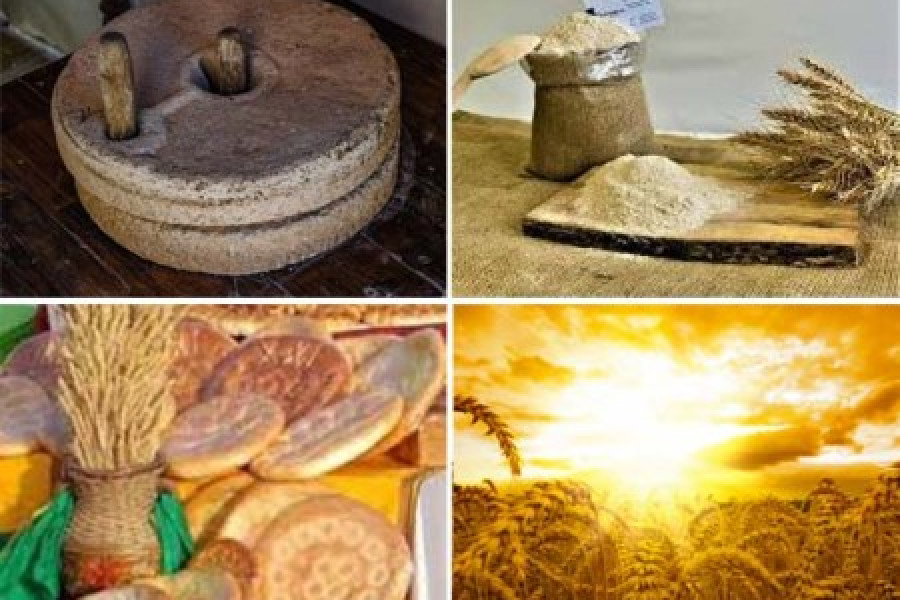
In the fortunate era of our sovereign state, thanks to the efforts of our esteemed President, our national values are studied scientifically. These values include our historical monuments, language, literature, ancient crafts, and much more. Looking back through history, one of the tools that has played a significant role in the lives of Turkmens is the mill.In ancient times, our ancestors typically ground grain in late July and early August, using large domestic animals to grind it on implements called "wheels." Several proverbs are associated with threshing and milling flour: "Whoever enters the threshing yard will turn to dust," "The threshing yard has a harp, and the kulak has a hammer," "The land of wheat is a mill," "The favorite grain will remain in the mill," "Even if there is three years of famine, the miller will not go hungry." Our people began using mills in ancient times. Millstones made for the millstone were polished and ground. Then, to ensure proper grinding of the flour, their surface was worked with a specially made steel hammer with two grooves or an old cast-iron wheel, creating a rough, battered, and jagged surface. The lower and upper millstones were called "pay."In some parts of the country, the upper millstone was also called "ostunlik," and the lower millstone, "astynlyk." A hole was made in the center of the lower millstone through which a round piece of wood was passed. Due to the roundness of this wood, its resemblance to a sphere, it was called "topagach." A hole was made in the center of the upper millstone for adding wheat and barley. This hole was called a "dol." A piece of wood with a horizontal hole in the middle was placed into this hole. The name of this wood was "filek" or "dzhikirik." Dzhikirik was used for ordinary grain grinding. A thin, long log of strong, healthy wood, similar to an ylgyn, was passed through a hole in the lower millstone and placed in the hole in the center of the wheel. The upper millstone also rotated around this wheel with the help of a wheel. For this reason, a proverb arose in Turkmen folklore: "A girl's appearance is in her face, but a mill is free in her wheel." In addition to hand mills, there were also grain mills powered by water, wind, and livestock. Furthermore, there were large mills for grinding the entire village's harvest. The people who worked these mills were called "kilvans." Water and windmills are remarkable monuments to the material, cultural, and historical heritage of our people. They appeared in the 2nd-4th centuries AD and served our people until the second half of the 20th century. Thus, a mill was built by one, two, or three wealthy individuals, and they owned it jointly. It's no coincidence that Turkmens say, "My mill is a beautiful mill." Turkmens considered watermills sacred because the Prophet David touched them. They maintained strict cleanliness in and around the mill. Clearly, water was essential for the operation of a watermill. It flowed in particularly large quantities and with a strong current, driving millstones weighing up to 100 kilograms. This is why the proverb, "Everyone has a problem, but the miller has water," arose for a reason. We are grateful to the National Leader of the Turkmen people and Arkadagly Hero Serdar for creating all the opportunities for studying and worldwide popularization of the culture and history of our ancestors in the Era of the revival of a new era of a powerful state. We wish the National Leader, Arkadagly Hero President good health, longevity and success in his noble activities of universal significance.
